Kathoey Meaning: Ladyboy vs Trans Language Guide

Most visitors to Thailand arrive with one word in their vocabulary: "ladyboy." It is the term plastered on tourist brochures, comedy shows, and nightlife menus from Bangkok to Pattaya. The problem is that it is also the term that many members of the community find inaccurate, reductive, or outright disrespectful. Understanding kathoey meaning, how it differs from "ladyboy" and "transgender," and which terms locals actually use is not just cultural etiquette. It is the difference between genuine engagement with one of Thailand's most visible communities and the kind of clueless tourism that locals have quietly rolled their eyes at for decades.
Table of Contents
Quick Takeaways
Key Insight
Explanation
Kathoey is a broad umbrella term
It covers transgender women, effeminate gay men, and those who identify as a third gender. It does not map neatly onto "trans woman."
"Ladyboy" is a tourist-facing term
It is widely used in English but can feel inaccurate or disrespectful to many individuals in the community. It is not how most Thais speak about kathoey among themselves.
Most Thai transgender women prefer "phuying"
A study of 195 Thai transgender women found that most identified as
phuying
(woman), not kathoey. Using this is a sign of respect.
Sao praphet song is the community's preferred formal term
Translating roughly as "second-type female," it aligns with a female gender identity and is considered more polite than kathoey in most contexts.
Kathoey has Khmer roots, not Thai
The word originates from the Khmer
khteuy
and was historically used to describe intersex or androgynous individuals before its meaning broadened.
"Transgender" as a Western framework does not translate perfectly
The Thai concept of kathoey involves a third gender category rooted in Buddhist cosmology, not simply a binary transition as understood in Western discourse.
Context determines which term is appropriate
In activist and rights-based settings,
phu ying kham phet
(transgender woman) is used. In everyday life, following the individual's lead is always the safest approach.
What Kathoey Actually Means
Kathoey (Thai: กะเทย, pronounced roughly kàtʰɤːj) is a term used in Thailand, as well as in Cambodia and Laos, to describe people who were assigned male at birth and who present as transfeminine or effeminate. In practice, the term functions as an umbrella, covering transgender women, people who identify as a third gender, and in some uses, effeminate gay men. The English translation most people know is "ladyboy," but that rendering strips out a great deal of cultural and historical nuance.
One important thing to understand from the start: using kathoey as a synonym for "trans woman" is not quite right. The term carries an implication that the person is, at some level, a type of male who expresses femininity, which is very different from the Western understanding of a transgender woman who identifies fully as female. This distinction matters to many individuals within the community, which is why other terms have emerged.
Pro tip: When in doubt, follow the person's lead. If someone introduces herself simply as a woman, call her a woman. The community is not monolithic, and no single term fits everyone.
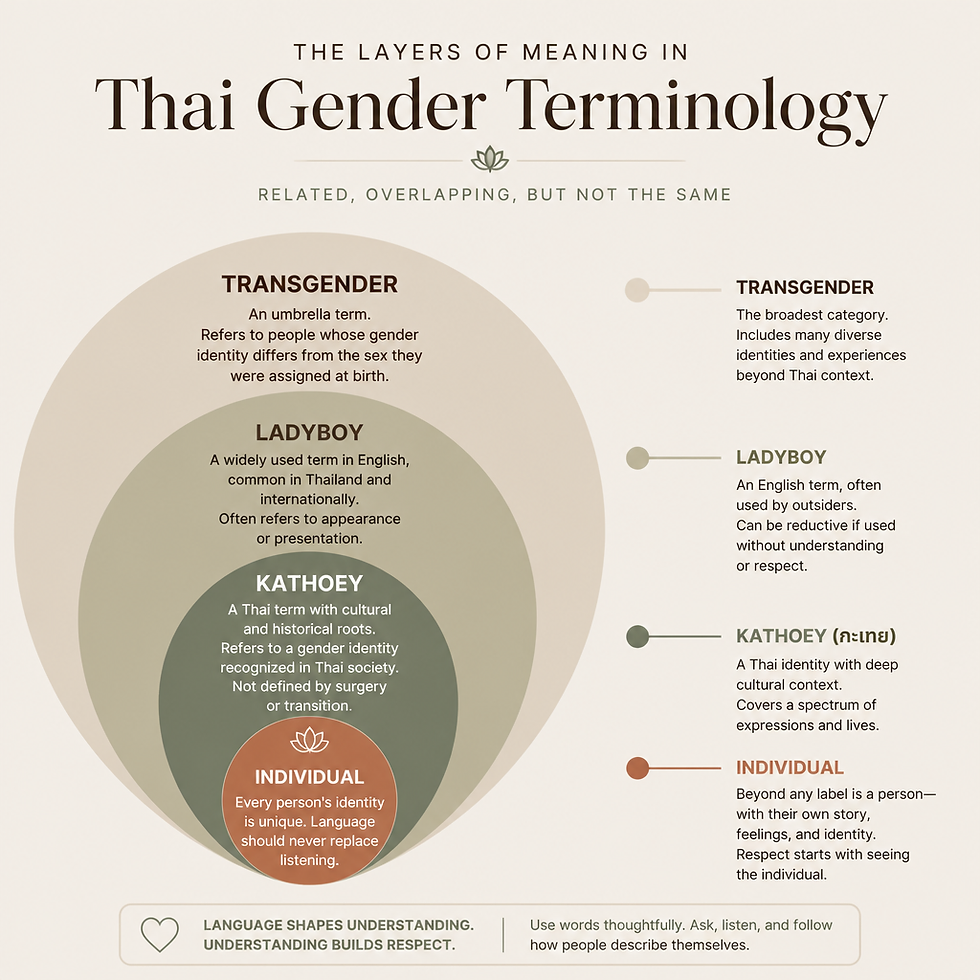

The Etymology: Where Does the Word Come From?
The word kathoey is of Khmer origin, derived from khteuy (ខ្ទើយ). It entered the Thai language and, over centuries, shifted considerably in meaning. Mid-19th century Thai dictionaries described a kathoey as a person who is neither distinctly male nor female, an early definition closer to what we might now call intersex or androgynous. Before the 1960s, the term was applied broadly to anyone who deviated from dominant sexual and gender norms, including individuals we might today describe as gay, cross-dressing, or intersex.
Today, the Royal Institute Dictionary still includes that historical definition, but common usage has narrowed in some directions and broadened in others. The key point for visitors: this is a word with a long, layered history, not a simple English loanword coined for tourist marketing.
The Full Glossary of Thai Gender Terms
Most guides stop at "kathoey = ladyboy." That is like stopping a Thai language lesson at sawadee. If you want to talk about Thai gender identity with any accuracy, you need to know the full vocabulary that locals actually use.
Phuying (ผู้หญิง)
Phuying simply means "woman." It is the term that the majority of Thai transgender women use to refer to themselves, according to research that surveyed 195 Thai transgender women. Most identified as phuying rather than as kathoey. Using this word when a transgender woman has indicated she identifies as a woman is a straightforward act of respect, not a complicated political statement.
Sao Praphet Song (สาวประเภทสอง)
Sao praphet song translates as "second-type female" or "second kind of woman." It is widely considered the most polite and respectful term within the community itself. Unlike kathoey, which can imply a male base identity, sao praphet song positions the person within a female identity category. It is the term you will most often hear used in formal settings, media coverage, and by community advocates. The closely related form phuying praphet song carries the same meaning.
Phet Thi Sam (เพศที่สาม)
Phet thi sam means "third sex" or "third gender." It is a more philosophical framing, used when discussing the broader concept of a gender category that exists outside the male/female binary. You will see this term in academic writing and cultural commentary more often than in everyday conversation.
Phu Ying Kham Phet (ผู้หญิงข้ามเพศ)
This term translates directly as "transgender woman." It is used primarily in activist, legal, and rights-based contexts. As Thai LGBTQ+ advocacy has grown, phu ying kham phet has become the standard term in formal documents and campaigns, aligning Thai language with international human rights frameworks.
Terms That Have Become Pejorative
A few terms that circulate in tourist areas carry significant negative weight within the community. Tootsie is widely considered an insult. The term pratheuang (ประเทือง) became a pejorative after a popular song in 1998 used it in a mocking context. Outsiders using these terms may not realize the weight they carry, but community members certainly do.
Ladyboy vs Transgender Thailand: How the Terms Differ
The ladyboy vs transgender Thailand distinction is one of the most misunderstood aspects of Thai gender culture among foreign visitors. The short version: "ladyboy" is an English-language tourist term, while "transgender" is a Western conceptual framework that does not map cleanly onto Thai cultural reality.
"The term ladyboy is widely used by tourists but can feel inaccurate or disrespectful to some. Kathoey is more accurate in the Thai context."
"Ladyboy" emerged as an English rendering of kathoey and spread across Southeast Asia as tourism to Thailand grew. It is the term you will see on cabaret show signs, in travel blog headlines, and in nightlife guides aimed at foreign visitors. Within the Thai community, its usage is complicated. Some individuals in the community use it themselves with ownership and humor. Others find it reductive, sexualizing, or a reminder that their identity has been packaged for outside consumption.
Why "Transgender" Is Not a Perfect Translation Either
"Transgender" as a Western concept implies a transition between two poles of a binary gender system: a person born male transitioning to female, or vice versa. The Thai understanding of kathoey identity is rooted in something fundamentally different. Buddhism, which shapes Thai cosmology more deeply than most Westerners appreciate, has historically recognized a third gender category rather than a binary. In this framework, a kathoey is not transitioning from one gender to another but occupying a recognized, if spiritually complex, third position. There is no binary to cross.
This is not to say that Western concepts of transgender identity are absent in Thailand. Many Thai individuals do identify as transgender in the contemporary sense, use the term phu ying kham phet, and engage with global LGBTQ+ frameworks. But applying a blanket "transgender" label to all kathoey individuals misrepresents a large portion of the community for whom that framing simply does not apply.
Pro tip: Avoid saying "she is transgender" as a default when referring to a kathoey individual you do not know personally. "She is kathoey" or, better, simply using her preferred name and pronouns, is less presumptuous.

The Buddhist and Historical Roots
One of the most important things to understand about Thai gender terminology is that it did not emerge in a vacuum. Thai gender identity has been shaped by centuries of Buddhist thought, and that context explains both the relative social visibility of the kathoey community and the particular way identity categories are structured.
Three Genders in Buddhist Cosmology
Early Buddhist scriptures reference three genders: man, woman, and a third category that maps, loosely, onto what we now call kathoey. This recognition does not mean the tradition has always been celebratory about the third gender. Buddhist texts in the Cambodian tradition, for instance, describe individuals being reincarnated as kathoey as a consequence of negative actions in previous lives. The existence of the category has long been acknowledged; the moral valuation attached to it has been more complex.
The practical effect is that Thailand developed a social framework with room for a third gender category, rather than the strict binary reinforcement that characterized much of Western religious tradition. This is why the kathoey community is so visible in Thai society, working openly in entertainment, retail, hospitality, and everyday life. Visibility is not the same as full equality, but it is a meaningful structural difference from many other cultural contexts.
How the 20th Century Changed the Terminology
Scholar Peter Jackson, who has written extensively on sexual politics in Thailand, notes that the term kathoey was historically used to refer to intersex individuals, and that its meaning shifted in the mid-20th century to cover cross-dressing males more broadly. Before the 1960s, the term encompassed anyone who deviated from dominant sexual norms. The subsequent narrowing and broadening of its usage tracks the changes in Thai society more broadly, including the influence of Western medicine, tourism, and global media on how gender identity is understood and discussed.
Term Comparison: Kathoey, Ladyboy, and Sao Praphet Song
Term
Who Uses It and When
Implications and Cautions
Kathoey
(กะเทย)
Thais in everyday conversation; academic and media contexts; sometimes used self-referentially within the community
Broad umbrella; can imply a male base identity; can be used as an insult depending on tone. Not all individuals it describes accept it.
Ladyboy
Tourists, English-language media, nightlife marketing; sometimes used self-referentially by performers
Widely understood internationally; considered reductive or offensive by many community members; strongly associated with nightlife tourism rather than everyday identity
Sao Praphet Song
(สาวประเภทสอง)
Community members, formal settings, journalism, rights-based contexts; widely preferred within the community
More respectful and precise than kathoey; implies a female identity; generally the safest choice when using a Thai term
What to Say and What to Avoid as a Visitor
Knowing the terminology is only half the equation. The other half is knowing how to apply it in practice, because getting this right in a conversation is very different from passing a terminology quiz.
The Simplest Rule: Follow the Individual's Lead
The community is not homogeneous. Some individuals identify fully as women and find any gender-specific terminology other than "woman" unnecessary or offensive. Others identify proudly as kathoey as a statement of distinct Thai cultural identity. Still others use sao praphet song in formal settings and kathoey informally. The individual in front of you is the only authority on what she prefers.
In practice, this means listening before labeling. If someone introduces herself using a specific Thai term or in a specific way, mirror that. If you do not know, using "she" and her name is always safe until you learn more. What is never appropriate is opening with "ladyboy" as a descriptor for someone you have just met, in the same way you would not introduce a Western trans woman to strangers by her transition history.
In Bars and Nightlife Settings
Much of the context in which foreign visitors encounter Thai gender terminology is in bars and entertainment venues, where "ladyboy" is the dominant marketing language. It is worth knowing that this commercial environment does not reflect the broader community's own vocabulary. A performer in a Patpong cabaret show who is marketed as a "ladyboy" may or may not use that term about herself in her personal life.
Within nightlife settings, using kathoey is generally less jarring than "ladyboy" because it at least signals some awareness of Thai terminology. But the strongest signal of respect is simply using the person's name and preferred pronouns, which is almost always a good first move regardless of cultural context.
Common Mistakes Visitors Make
The most common mistake is treating all three terms, kathoey, ladyboy, and transgender, as interchangeable synonyms. They are not. Another frequent error is assuming that every kathoey individual has had or is seeking gender-affirming surgery. Some have; some take hormones and have breast augmentation but no surgery; some make no physical alterations at all. The term covers a wide spectrum of presentations and identities, and projecting a single narrative onto that spectrum is the kind of overgeneralization that erodes real engagement with the community.
A third mistake, common among visitors who consider themselves culturally aware, is overusing the term sao praphet song to the point of sounding clinical. In casual conversation, if someone identifies as a woman, calling her a woman is fine and actually more respectful than reaching for a specialized term. Specificity has its place, but so does simplicity.
If you want to go deeper on the social and etiquette dimensions of these interactions, the guides on respectful engagement with Thai ladyboy culture cover dating customs, bar etiquette, and pronoun use in detail.
Frequently Asked Questions
What is the literal meaning of kathoey?
The word kathoey originates from the Khmer term khteuy and was historically used to describe a person who is neither distinctly male nor female. In modern usage, it functions as a broad umbrella term covering transgender women, effeminate gay men, and individuals who identify as a third gender. Mid-19th century Thai dictionaries defined it as a person between or outside the male/female categories, and that ambiguity remains embedded in the term today.
Is "ladyboy" offensive in Thailand?
"Ladyboy" is widely used in tourist contexts and is understood internationally, but many community members consider it inaccurate, reductive, or disrespectful because it reduces a complex identity to an English-language tourist convenience. Kathoey is more culturally grounded, and sao praphet song is generally considered the most respectful Thai-language option. That said, some individuals within the community use "ladyboy" themselves, so context and the individual's own preference always matter.
How is kathoey different from being transgender?
"Transgender" is a Western framework that presupposes a binary gender system and describes a transition between male and female. Kathoey is rooted in Thai Buddhist cosmology, which has historically recognized a third gender category that exists alongside, rather than between, male and female. Many kathoey individuals do not see themselves as transitioning at all, but as occupying a distinct third category. Some Thai individuals do identify using the term phu ying kham phet (transgender woman) in alignment with international frameworks, but the two concepts are not identical.
What term do Thai transgender women prefer for themselves?
Research involving Thai transgender women found that the majority identified simply as phuying, meaning "woman." A smaller number used phuying praphet song or sao praphet song, meaning "second-type woman." Very few used kathoey as a self-description. In activist and formal contexts, phu ying kham phet (transgender woman) is increasingly common. The takeaway for visitors: if a Thai woman identifies as a woman, that is how you should refer to her.
What are the Thai terms I should actually know before visiting?
The five most important terms are: kathoey (the broad cultural term, Khmer origin); phuying (woman, the most common self-identification among transgender women); sao praphet song (second-type female, the polite community-preferred term); phet thi sam (third sex, a philosophical framing); and phu ying kham phet (transgender woman, used in rights-based contexts). You do not need to deploy all of these in conversation, but knowing they exist prevents the common error of treating "kathoey" and "ladyboy" as the only options.
Can kathoey be used as an insult?
Yes. Like many identity terms, kathoey can be used respectfully or as a slur depending entirely on context, tone, and who is saying it. When used by someone outside the community to mock or belittle an individual, it is understood as an insult. Used neutrally or respectfully, especially by people who understand its cultural context, it carries no inherent offense. The terms tootsie and pratheuang are more clearly pejorative and should be avoided entirely by visitors.
If you have spent time in Thailand and have your own experience navigating these terms, share what worked for you in the comments below. Real on-the-ground perspectives are more useful than any guide.
References
Wikipedia overview of kathoey: history, terminology, and cultural context in Thailand
Nonbinary Wiki entry on kathoey covering Thai usage and the pejorative dimension of the term
Academic paper on kathoey terminology, sao praphet song, and Thai transgender identity language
Write Inclusion factsheet on kathoey as a gender identity in Thailand


Comments