Thai Body Language Guide: Social Cues Travelers Misread

Most travelers land in Thailand thinking a smile means yes, a nod means agreement, and a wai is just a polite wave with extra steps. They leave still believing that. The truth is that Thai nonverbal communication runs on an entirely different operating system, and misreading it does not just lead to awkward moments. It leads to offense, missed connections, and interactions where both parties walk away confused about what just happened. This Thai body language guide is built for people who want to go deeper, especially those engaging with Thai communities beyond the tourist surface, including the ladyboy community, where reading subtle social cues can make the difference between genuine connection and unintentional disrespect.
Table of Contents
Quick Takeaways
Key Insight
Explanation
The head is sacred, the feet are spiritually low
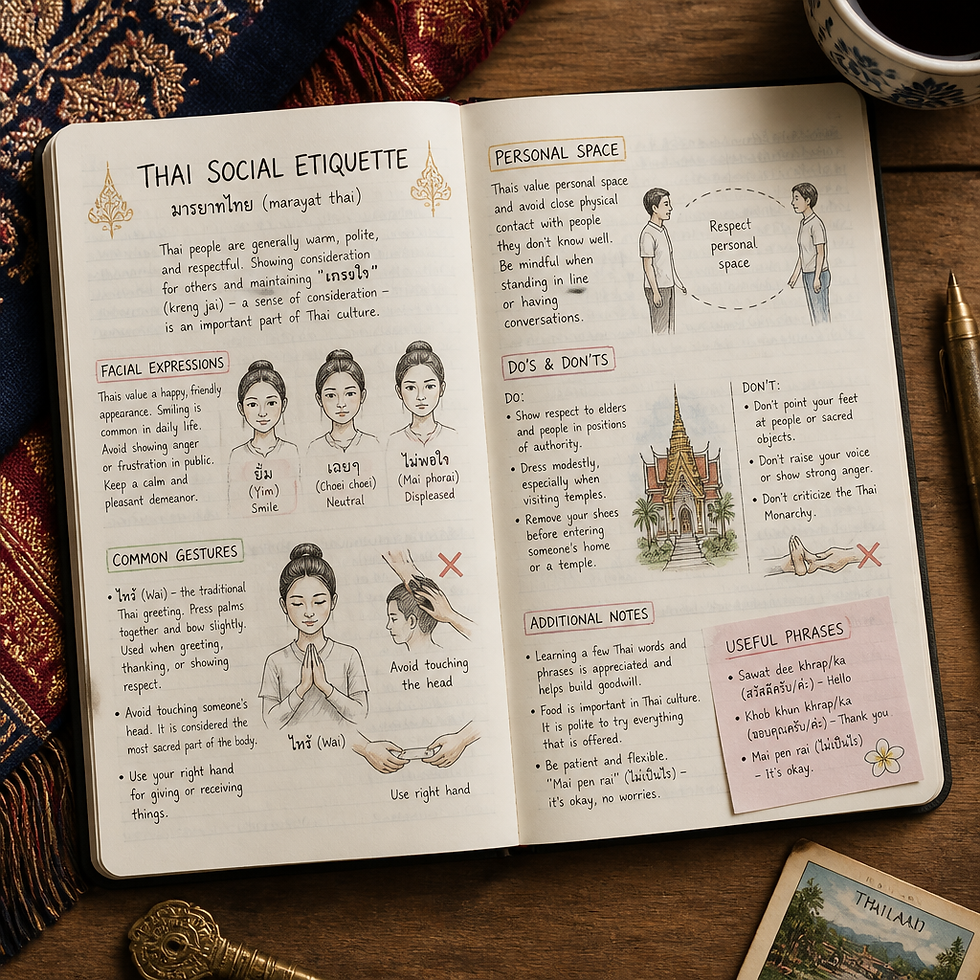
Never touch someone's head without invitation, and never point your feet at a person, a Buddha image, or a monk. This hierarchy governs posture, object passing, and spatial positioning.
The wai is status-coded, not interchangeable
The height of your hands during a wai signals the relative status between you and the other person. Using the wrong level communicates either arrogance or excessive deference.
A smile does not equal happiness or agreement
Thai culture uses smiling to manage discomfort, mask embarrassment, soften a refusal, or diffuse tension. Reading a smile as simple friendliness will mislead you constantly.
Kreng jai makes direct "no" almost culturally impossible
The concept of kreng jai, consideration for others' feelings, means Thais will often say "maybe," go quiet, or smile rather than deliver a direct refusal. Silence is frequently a soft no.
Pointing with a single finger is rude
Use an open hand or a slight chin gesture to indicate direction or a person. A pointed index finger carries a hostile or condescending tone in Thai social spaces.
Public physical affection is read differently by Thais
Same-gender friends holding hands is common and platonic. Heterosexual couples kissing publicly is still considered inappropriate in many contexts, especially outside tourist zones.
Lowering your body shows respect in hierarchy moments
Physically crouching or bowing slightly when passing between seated people or in front of elders is expected. Standing tall and walking through is considered dismissive.
The Head and Feet Hierarchy: Spiritual Anatomy Every Visitor Gets Wrong
Thai culture treats the human body as a vertical map of spiritual value. The head sits at the top of this hierarchy, considered the most sacred part of the body, closest to the heavens and housing a person's soul and consciousness. The feet occupy the opposite extreme, spiritually low and associated with the earth, dirt, and accumulated impurity. This is not symbolic metaphor that Thais apply loosely. It is a deeply lived framework that shapes behavior in temples, homes, offices, and every social interaction in between.
Touching someone's head, even a child's head in a friendly ruffle, is a genuine violation in this framework. Many Western travelers interpret ruffling a child's hair as affectionate. In Thailand it can read as an insult or, at minimum, a culturally jarring intrusion. The same rule applies regardless of whether you are interacting with Thai men, women, or members of the ladyboy community. Respect for this hierarchy is universal across gender expression in Thai culture.


The feet carry their own set of rules. Pointing your feet toward another person, a Buddha image, a monk, or a sacred object is considered deeply disrespectful. This means sitting cross-legged carelessly at a temple, stretching your legs toward the altar, or propping your feet on furniture in a social setting all register as offensive to Thai observers who may say nothing to your face but will form a lasting impression. When sitting in social or temple spaces, tuck your feet underneath you or sit cross-legged with soles facing down and away from others.
Passing objects is also governed by this logic. Pass things with your right hand, or with both hands. Handing something across with your left hand alone is considered impolite, as the left hand has traditionally been associated with hygienic tasks. Never push something across a table with your foot, and do not use your foot to stop a rolling coin, even if that coin bears the king's image, which compounds the offense significantly.
Pro tip: When sitting in any Thai social setting, do a quick feet check. If your soles are pointing toward anyone in the room, quietly adjust. Nobody will point it out, but everyone will notice.
The Wai Decoded: More Than a Greeting
The wai is Thailand's most recognized gesture, but its mechanics are consistently misunderstood by visitors who treat it as a simple hello. The wai involves pressing your palms flat together, fingers pointing upward, and bringing them to a position between your chin and your forehead while giving a slight bow. The critical variable that most travelers miss is the height of the hands, which communicates the status relationship between you and the person you are greeting.
When greeting a monk or a sacred image, the fingertips rise toward the forehead or above. When greeting a social equal, the tips rest comfortably around nose or chin level. When acknowledging a service worker's wai toward you, a slight nod or a low, relaxed wai returned at chest level is sufficient. Returning an over-elevated wai to someone of lower social standing is not a gesture of humility in Thai eyes. It reads as either confusion about social dynamics or an attempt to imitate without understanding.
Children and social juniors are not typically expected to receive a full wai return from elders or those of higher status. In service environments, shop workers and hospitality staff often wai customers, and visitors are not obligated to return it formally. A warm smile and a slight nod is entirely acceptable and reads as gracious rather than dismissive.
Pro tip: Do not wai a child. Do not wai a street vendor in a transactional setting. The gesture carries social weight that comes across as performance when used indiscriminately. A genuine smile communicates warmth without the risk of getting the hierarchy wrong.
The Smile Problem: Thirteen Expressions, One Face
Thailand is frequently called the Land of Smiles, and that reputation is real, but it is also the source of some of the most persistent misreadings foreign visitors make. A smile in Thai social culture is not a one-dimensional expression of happiness. It functions as a sophisticated social tool for managing harmony, masking discomfort, softening difficult moments, and maintaining the appearance of ease when the inner reality is something else entirely.
"Visitors often mistake Thai calmness and gentle communication for shyness or passivity, when in reality it reflects a deeply ingrained cultural value: avoiding confrontation and preserving harmony."
A smile can mean genuine pleasure. It can also mean embarrassment. It can mean "I have no idea what you just said but I don't want you to feel bad about it." It can mean "I am extremely uncomfortable and this is the only face I can safely show right now." In contexts where someone has made a social error, including a foreigner unknowingly breaking a cultural rule, the Thai person is very likely to smile as the primary response. That smile is not forgiveness or indifference. It is a face-saving measure for both parties.
This matters enormously when you are in a social situation with a Thai ladyboy, or any Thai person, and you are trying to gauge whether a boundary has been crossed. A smile after a potentially inappropriate comment or gesture is not a green light. It is more often the opposite, a signal to redirect and recalibrate.
Watch the eyes alongside the mouth. A genuine smile of warmth typically involves the eyes narrowing slightly and crinkling at the corners. A socially managed smile often leaves the eyes neutral or slightly tense. This distinction takes practice, but it is real and consistent.
Kreng Jai and Indirect Communication: When "Yes" Means "I Can't Say No"
Kreng jai is one of the most important concepts in Thai social life and one of the most consistently missed by foreign visitors. The word translates roughly as consideration for others' feelings, specifically a reluctance to impose, inconvenience, or cause discomfort to the person you are speaking with. In practice, it means that Thais will frequently avoid direct refusals, negative feedback, or outright disagreement even when that is exactly what they mean.
The practical result is that a direct "no" is genuinely uncommon in Thai social communication. Alternatives you will encounter include "maybe," "it might be difficult," a vague smile with no verbal response, a change of subject, or a slow exhale followed by a polite deflection. All of these can be soft no's. Experienced travelers and expats learn to read these signals rather than pushing for verbal confirmation that is culturally uncomfortable to give.
In a dating or social context, this has clear implications. If a Thai person you are interacting with goes quiet, offers a vague answer, or begins smiling without engaging further, pressing for a clearer response is unlikely to produce one. It is more likely to produce a second layer of polite deflection and a lasting impression that you do not understand how to read people. The respectful response is to ease off, change the subject, and let the person signal comfort when they are ready.
This indirectness also shows up in how Thais communicate status and hierarchy nonverbally. Age and social standing are deeply respected. When entering a room with mixed ages, a subtle deferential posture toward elders, a slight lowering of the body or a more restrained personal energy, reads as socially fluent. Dominance body language that works well in Western professional contexts, strong eye contact, a commanding posture, a firm handshake, can come across as aggressive or socially unaware in Thai settings.
Pointing, Personal Space, and Touch: The Rules Nobody Tells You
Pointing with a single index finger toward a person is considered rude in Thai culture, and it is one of the gestures that travelers use constantly without realizing the impression it creates. The acceptable alternative is to use an open palm facing upward, or to indicate direction with a slight chin gesture, a subtle upward movement of the chin toward the thing or person you are referencing. This chin-point is so normalized in Thai communication that locals use it naturally in conversation without thinking about it. Visitors rarely notice it at all.
Thailand maintains what cultural researchers describe as a relatively low-contact culture, meaning casual physical touch between strangers or acquaintances is not the social norm. Backslapping, hugging upon first meeting, or placing a hand on someone's shoulder during conversation is not standard Thai greeting behavior. It can be tolerated from tourists, but it is not welcomed, and it often produces a slight stiffening of the body that goes unacknowledged verbally.
Same-gender touch between friends is a different story. Thai friends, including men, routinely hold hands, walk arm in arm, or sit close together without it carrying any romantic signal. This surprises many Western visitors, particularly those from cultures where same-gender physical closeness is more coded. In Thai culture, it simply signals friendship and ease. Reading it as anything else reflects a Western interpretive lens being applied to a different cultural reality.
Conversely, heterosexual couples kissing or engaging in overt public displays of affection are still regarded as socially inappropriate in many parts of Thailand, especially outside areas that are explicitly oriented toward international tourists. Warmth between partners is expected to be expressed with more restraint in public, through proximity, shared glances, and small gestures rather than physical contact.
Body Language in Thai LGBTQ+ Spaces and Nightlife
Thai society is often described as socially tolerant of gender diversity, and that tolerance is real in many contexts. But social tolerance is not the same as social equivalence, and the body language rules that govern mainstream Thai spaces do not disappear in LGBTQ+ or nightlife environments. They shift and layer rather than vanish entirely. Visitors who assume that a more relaxed venue means cultural rules are suspended tend to make the most noticeable errors.
When engaging with members of the Thai ladyboy community, the same core nonverbal principles apply as in any Thai social interaction. The head is still sacred. Kreng jai still shapes how a person responds to discomfort. A smile in response to an uncomfortable question is still more likely to be a face-saving deflection than genuine amusement. These are not bar-specific rules or nightlife-specific rules. They are Thai cultural defaults that travel with every person regardless of the setting.
What changes in these spaces is the calibration around directness and touch. Social venues, particularly those oriented around tourism, do develop their own hybrid norms that blend Thai cultural defaults with the expectations of international visitors. Even within that hybridity, reading a Thai person's body language well, noticing when enthusiasm is genuine versus performed, when comfort is real versus managed, is a skill that produces better interactions across every context.
For deeper context on respectful engagement, appropriate language, and how to interact meaningfully with Thailand's ladyboy community beyond surface-level nightlife, the guides at dating a Thai ladyboy and on Thai ladyboy pronouns and respectful language offer directly applicable cultural grounding.
Comparison: How Western vs. Thai Body Language Cues Differ
The table below maps three of the most commonly misread areas side by side. Use it as a quick reference before any social engagement in Thailand.
Social Cue
Western Interpretation
Thai Reality
Smiling in response to criticism or an uncomfortable question
The person is fine with it, agrees, or finds it amusing
The person is managing discomfort and preserving face for both parties. It is almost never a green light to continue.
Silence or vague answer after a direct question
The person is thinking, unsure, or needs more information
Very likely a soft refusal or expression of discomfort framed through kreng jai. Pushing for clarity usually produces a second layer of deflection, not directness.
Two men or two women holding hands in public
Often read as a romantic or sexual signal depending on the observer's cultural context
Standard expression of friendship. Carries no romantic connotation in mainstream Thai culture. Assuming otherwise reflects an outside interpretive framework, not local reality.
Direct sustained eye contact
Signals confidence, engagement, and trustworthiness
Can read as confrontational or aggressive, especially toward elders or authority figures. Softer, intermittent eye contact is more socially calibrated.
Wai returned at the same height it was given
Reciprocal gesture, mirrors respect
The height of a returned wai should reflect the actual status relationship, not simply mirror what was received. Mirroring without context can signal confusion about hierarchy.
Frequently Asked Questions
Is it offensive to wai back to everyone who wais me in Thailand?
Not offensive, but sometimes socially awkward. Returning a full elevated wai to a service worker or a child reads as unfamiliarity with how status dynamics work in the gesture. A warm smile and slight nod is a perfectly acceptable and gracious response in lower-formality situations. Save the full reciprocal wai for genuine social peers and situations where the relationship calls for it.
Why do Thai people smile when I have clearly done something wrong?
The smile is doing protective work for both of you. Thai social culture places enormous value on preserving face, for both parties, not just the person who made the mistake. Responding to a social error with a smile allows everyone to move forward without an explicit confrontation that would embarrass the visitor and create awkwardness for the Thai person who had to deliver it. The smile does not mean the error was unnoticed. It means the person is choosing harmony over correction.
How do I know if a Thai person is saying no without saying no?
Look for vague responses like "maybe," "it might be difficult," or "I'll try." Watch for a smile paired with silence where a verbal response would normally follow. Notice if the topic gets changed without resolution. None of these signals are accidents. In Thai communication, they are the culturally appropriate way to decline without forcing a direct refusal that causes discomfort to the person asking. Accepting these signals gracefully rather than pushing for explicit confirmation is what distinguishes a culturally aware visitor.
Does the head and feet hierarchy apply when interacting with Thai ladyboys?
Yes, completely. The head and feet hierarchy is a pan-Thai cultural value rooted in Buddhist cosmology and applies across all gender identities and expressions within Thai culture. Thai ladyboys, kathoey, and trans women in Thailand are Thai people first and the same nonverbal cultural logic applies. Touching someone's head without clear invitation, pointing feet toward a person in a resting position, or passing objects carelessly all carry the same weight regardless of the setting.
Is direct eye contact acceptable in Thai social settings?
Context matters significantly here. In peer-to-peer social interactions with people roughly your own age, comfortable eye contact is fine and natural. When interacting with elders, monks, or people of clearly higher social standing, sustained direct eye contact can read as aggressive or disrespectful. Slightly softer, intermittent eye contact combined with a respectful body posture is more appropriate in those situations and reads as social fluency rather than weakness.
Why do Thai people crouch or lower their bodies when walking past others?
This is a physical expression of the respect hierarchy. Passing in front of seated people, particularly elders or people of higher social status, while standing at full height is considered dismissive in Thai culture. Slightly lowering your posture, crouching a little or bowing your head while passing, acknowledges their presence and your awareness of relative status. It is brief, automatic for Thais, and conspicuously absent when visitors walk tall through a room without it.
What should I know about touch norms before visiting Thai bars or social venues?
Thailand maintains relatively restrained norms around casual touch between strangers even in social venues. Initiating touch without a clear invitation, grabbing someone's arm to get their attention, placing a hand on a shoulder uninvited, or pulling someone closer, can feel intrusive regardless of the social energy in the room. Watch for reciprocal signals. If someone is leaning toward you, maintaining proximity, and engaging with open body language, that is an invitation. If they are slightly angled away, maintaining conversational distance, and smiling with minimal eye contact, read that as a boundary, not shyness to push through.
If you have spent time in Thailand and caught yourself misreading a social cue in the moment, we would genuinely like to hear what it was and how you recalibrated.
References
Comprehensive guide to Thai nonverbal communication, the wai, and body hierarchy
Thai etiquette rules on the head, feet, and the wai from Frommer's travel guide
Thailand Foundation guide to head and feet etiquette in Thai culture
Unspoken rules of Thai social life and cultural communication norms
Thai workplace and social cultural considerations including kreng jai and indirect communication


Comments