Kathoey History Thailand: A Cultural Guide for Travelers

Updated: Oct 1
Start here: our full guide, Katoey (Kathoey): What the Word Means and Life in Thailand Today, on katoey.com.
Most travelers arrive in Thailand having heard the word "ladyboy" but knowing almost nothing about kathoey history in Thailand. They see the cabaret posters, the beauty pageant banners, and the bar hostesses, and they assume this is a modern phenomenon built for tourism. It is not. The kathoey identity is woven into Thai culture across centuries of Buddhist doctrine, royal law codes, and pre-Buddhist origin myths. Understanding that history does not just make you a more respectful visitor. It fundamentally changes how you see every interaction, every performance, and every conversation you have with the community while you are here.
Table of Contents
Quick Takeaways
Key Insight
Explanation
Kathoey is not a modern invention
Northern Thai creation myths dating to at least the fifteenth century describe a three-gender system: male, female, and kathoey. This predates modern tourism by centuries.
The term is broader than "transgender"
Kathoey is a local category that can encompass transgender women, effeminate gay men, and intersex individuals. It does not map neatly onto any single Western identity label.
Buddhism shaped public tolerance, not full acceptance
Theravada Buddhist doctrine provided a karmic framework that explained kathoey existence without criminalizing it, but this same framework still attached moral weight to that identity.
Ancient Thai law formally restricted kathoey rights
Under the Code of the Three Great Seals, revised during the reign of King Rama I, kathoey were listed among those who could not serve as court witnesses.
Visibility is high; legal equality is not
Kathoey appear in mainstream media, sport, and entertainment, but Thailand still has no legal process for changing official gender markers on identity documents.
Western influence tightened gender norms
Although Thailand avoided formal colonization, Western-influenced binary gender standards gradually reduced the cultural flexibility that had historically accommodated kathoey identity.
Same-sex marriage passed in 2025
In January 2025, Thailand became the first country in Southeast Asia where same-sex marriage took legal effect, a milestone after over two decades of activism.
What Does Kathoey Actually Mean?
The word "kathoey" is derivationally unrelated to the Pali scriptural terms it is often used to translate, which strongly suggests it originated as an indigenous pre-Buddhist Thai concept for non-normative gender or sexuality. It is not simply a borrowed religious label. It is a home-grown term that the Thai people applied to their own understanding of a third human category long before Theravada monks arrived with their canonical texts.
In practice, the term has always been broad. Kathoey can refer to transgender women, to gay men with a highly feminine presentation, and historically to intersex individuals. Western visitors frequently try to collapse it into "transgender woman" and leave it at that, but that narrowing loses the cultural texture of the word. A kathoey in a rural village fair beauty pageant and a post-operative transgender woman working as a model in Bangkok may both use the term, but their experiences and self-understandings differ considerably.
Researchers note that in earlier usage, kathoey referred more broadly to anyone who deviated from the prevailing male-female divide, and it was only over time that the word became more strongly associated with male femininity and transfemininity specifically. Knowing this helps travelers understand why older Thai people and younger urban kathoey may use the same word to mean subtly different things.
Pro tip: When speaking with kathoey individuals, follow their lead on preferred language. Many younger kathoey in Bangkok actively use the English word "transgender" or the Thai phrase "phuying kham phet" (roughly, "cross-gender woman") rather than kathoey, which some find carries an outdated or stigmatizing tone. Asking respectfully what someone prefers is always better than assuming.


Pre-Buddhist Origins: The Three-Gender Model
Northern Thai legend and creation myth describe the pre-modern Thai sex and gender system as built on a model of three genders: male, female, and kathoey. A Yuan creation myth, the Pathamamulamuli, which scholar Anatole-Roger Peltier translated in 1991, dates back to at least the fifteenth century and contains themes reflecting a mixture of pre-Buddhist and Buddhist beliefs that were common across Southeast Asian religious texts of the period. The Yuan are part of the broader Tai ethnic group, and related Tai peoples across what is now northeast Thailand, Laos, and Myanmar share versions of this same origin story.
Buddhist origin myths carried this three-gender cosmology into the canonical sphere, describing three original human sexes: male, female, and biological hermaphrodite or kathoey. This three-sex model remained the dominant framework in Thailand until roughly the mid-twentieth century, when Western binary gender standards began asserting stronger cultural influence.
Why Thailand's Non-Colonial History Matters
Thailand is the only nation in its immediate region that successfully resisted formal colonization by European powers. Scholars have argued that this historical fact is directly relevant to gender. Countries that were colonized had Western normative heterosexuality and binary gender imposed on them through law, religion, and education systems. Thailand's relative independence meant its indigenous gender frameworks survived longer and with fewer official disruptions. This does not mean Thai society was a utopia of gender freedom. But it does mean that the three-gender cultural model had more room to breathe here than it did in neighboring countries under colonial administration.
Buddhism, Karma, and the Third Sex
When Theravada Buddhism arrived in Thailand, around the eleventh and twelfth centuries, it brought its own textual framework for understanding gender variance. The Buddhist scriptures known as the Tipitaka identify four genders: male, female, ubhatobyanjanaka (having characteristics of both), and pandaka, a Pali term that Thai interpreters translated as kathoey. The karmic account of the origins of kathoey identity held that being born as a kathoey was the result of sexual misconduct in a past life, specifically heterosexual misconduct.
This framework is more nuanced than it first appears. On one hand, it explained kathoey existence without criminalizing it. Because the condition was seen as the result of past-life karma rather than a choice in this life, kathoey were viewed as pitiable rather than morally culpable in the present. Thai Buddhists were broadly expected to extend compassion rather than hostility, and this attitude has historically made Thailand more socially tolerant of kathoey visibility than many other Asian nations. On the other hand, the same karmic framework attached a moral stigma to the identity, linking it to past wrongdoing and positioning it as something that would ideally cease to exist in a morally perfected cosmos.
Understanding that kathoey visibility in Thailand has always existed alongside moral ambivalence, rather than full acceptance, is the key to reading Thai society honestly rather than through a tourist filter.
The Tipitaka also explicitly barred kathoey from ordination as Buddhist monks. This restriction placed a real social ceiling on kathoey religious participation in a country where the Buddhist sangha, the monastic community, was historically one of the primary routes to social prestige and advancement for men.
Pro tip: If you visit a Thai temple and want to understand the cultural position of kathoey, look at the murals and carvings. Many Thai wats contain imagery referencing the cosmological world in which beings exist across multiple gender categories. This is not window dressing. It reflects a genuine theological engagement with the question of gender that has shaped Thai society for centuries.
Ancient Thai Law and the Kathoey
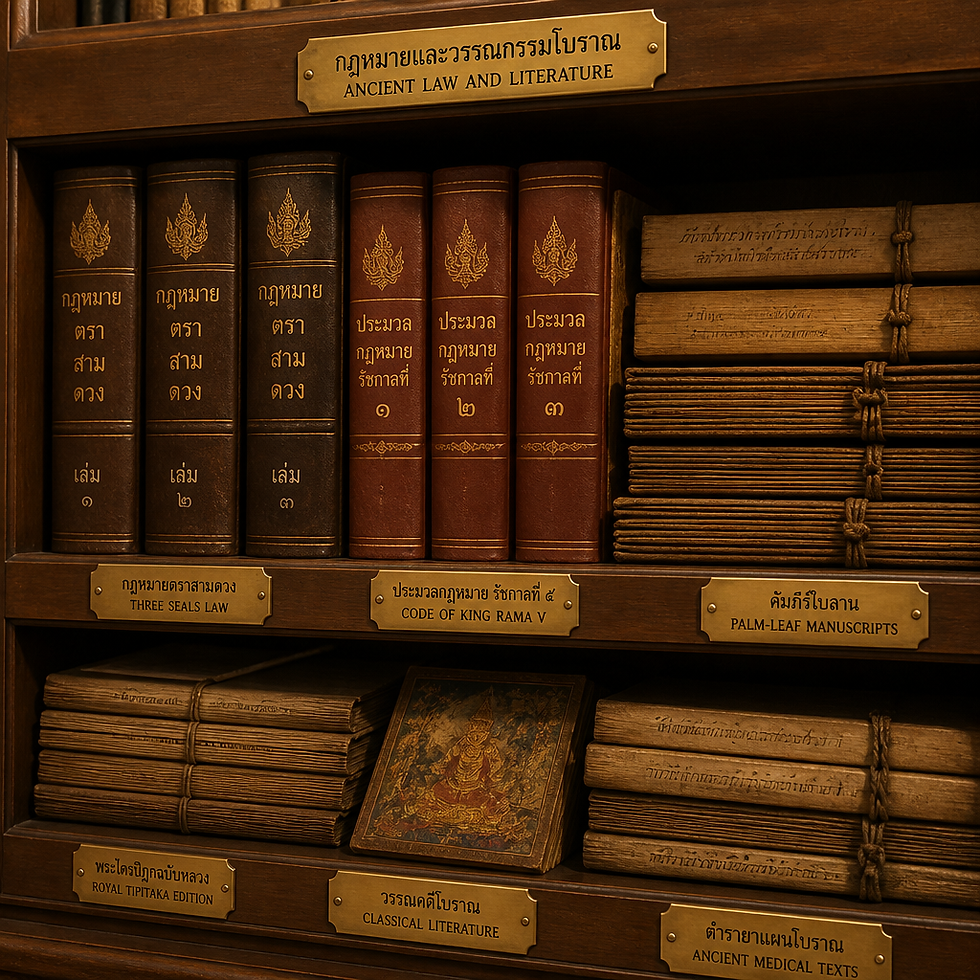
The treatment of kathoey in official Thai law codes tells a complicated story. Under the Code of the Three Great Seals, the ancient Thai legal compilation revised during the reign of King Rama I between 1782 and 1809, kathoey were listed among 33 categories of people who could not serve as witnesses in a court of law. This is a significant legal disability in any society, and it reflects the formal state position that, despite cultural tolerance, kathoey occupied a subordinate civic standing.
Separately, royal court law during the same general period included provisions penalizing certain same-sex acts among ladies-in-waiting. The existence of these statutes confirms that same-sex and cross-gender behavior was visible enough to warrant official attention, but the response was restriction rather than erasure. Thai law historically acknowledged the reality of gender variance without granting it equal standing.
This legal ambiguity, present and acknowledged but not equal, is a pattern that persists into the present day. It is not a new tension created by modernity. It is a continuity running from medieval court law to twenty-first-century constitutional debates.
Colonialism, Western Influence, and the Narrowing of Identity
Even without formal colonization, Western cultural influence arrived in Thailand through trade, diplomacy, missionary activity, and eventually mass media. The effect on gender norms was real. The pre-modern three-gender model, in which kathoey occupied a recognized if subordinate position in the cosmological and social order, gradually gave way to a more rigid binary framework. By the mid-twentieth century, Thai society was operating with the male-female binary as the primary public norm, with kathoey identity repositioned from a recognized third category to a deviation from two accepted ones.
This shift had practical consequences. As the binary tightened, the economic paths available to kathoey narrowed. The familiar pattern of overrepresentation in entertainment, beauty, and sex work reflects not a cultural preference but a structural exclusion from many other professional paths. The glamour of the cabaret stage and the beauty salon, both genuine kathoey cultural spaces, grew partly because other spaces closed.
How the Word "Ladyboy" Entered the Picture
The English word "ladyboy" is largely a tourism-era coinage, popularized through Western travel writing and bar culture from roughly the 1970s onward. It carries a different set of associations than kathoey does. Where kathoey connects to a deep local cosmological tradition, "ladyboy" often functions as a voyeuristic tourist label, useful for marketing but frequently resented by the community it describes. Travelers who use kathoey or, better still, ask what an individual person prefers are aligning themselves with the cultural history rather than the tourism industry's shorthand.
Kathoey in Modern Thai Society: Visibility Versus Equality
Thailand makes kathoey conspicuously visible in public life. Kathoey are models, singers, actors, competitive volleyball players, and Muay Thai fighters. Kathoey beauty pageants are popular not just in Bangkok but in small towns and at local fairs across the country. Entertainment and cabaret have made kathoey figures a staple of mainstream Thai media, and social media has extended that visibility further. A foreign visitor might reasonably conclude from this that Thai society has fully accepted the kathoey community.
The reality is more complicated. Behind that visibility, discrimination at work, at school, in healthcare settings, and on official documents remains routine. Human Rights Watch documented cases in which kathoey job applicants were explicitly told during interviews that only men and women were acceptable candidates. A kathoey visiting a hospital reported being outed publicly by a triage nurse who announced her status loudly in the waiting room. These are not rare exceptions. They are the background texture of daily life for many kathoey, invisible to the tourist who spends a week in Thailand and sees only the pageant stage and the cabaret.
Kathoey in Sport and Professional Life
The participation of kathoey in national sports teams, including volleyball, is a genuinely interesting cultural data point. Some kathoey athletes choose to deemphasize feminine presentation in competitive contexts without abandoning their gender identity entirely. This reflects a practical flexibility in how Thai society navigates kathoey visibility in mainstream spaces. It is not full equality, but it is evidence that kathoey participation in public life extends well beyond the entertainment roles most tourists associate with the community.
Legal Status and Rights Today
Thailand's legal position on kathoey and transgender rights is a patchwork of partial progress. The Gender Equality Act of 2015 prohibits discrimination against persons whose appearance or expression differs from their sex assigned at birth, covering domains including housing and employment. This provided a constitutional foundation that had not previously existed, though enforcement has been inconsistent.
The most significant recent development is Thailand's legalization of same-sex marriage. The bill passed its final Senate reading in June 2024 and came into effect on January 22, 2025, making Thailand the first country in Southeast Asia to reach this milestone. The legislation uses gender-neutral language, guarantees same-sex couples the right to adopt, and secures inheritance and healthcare rights.
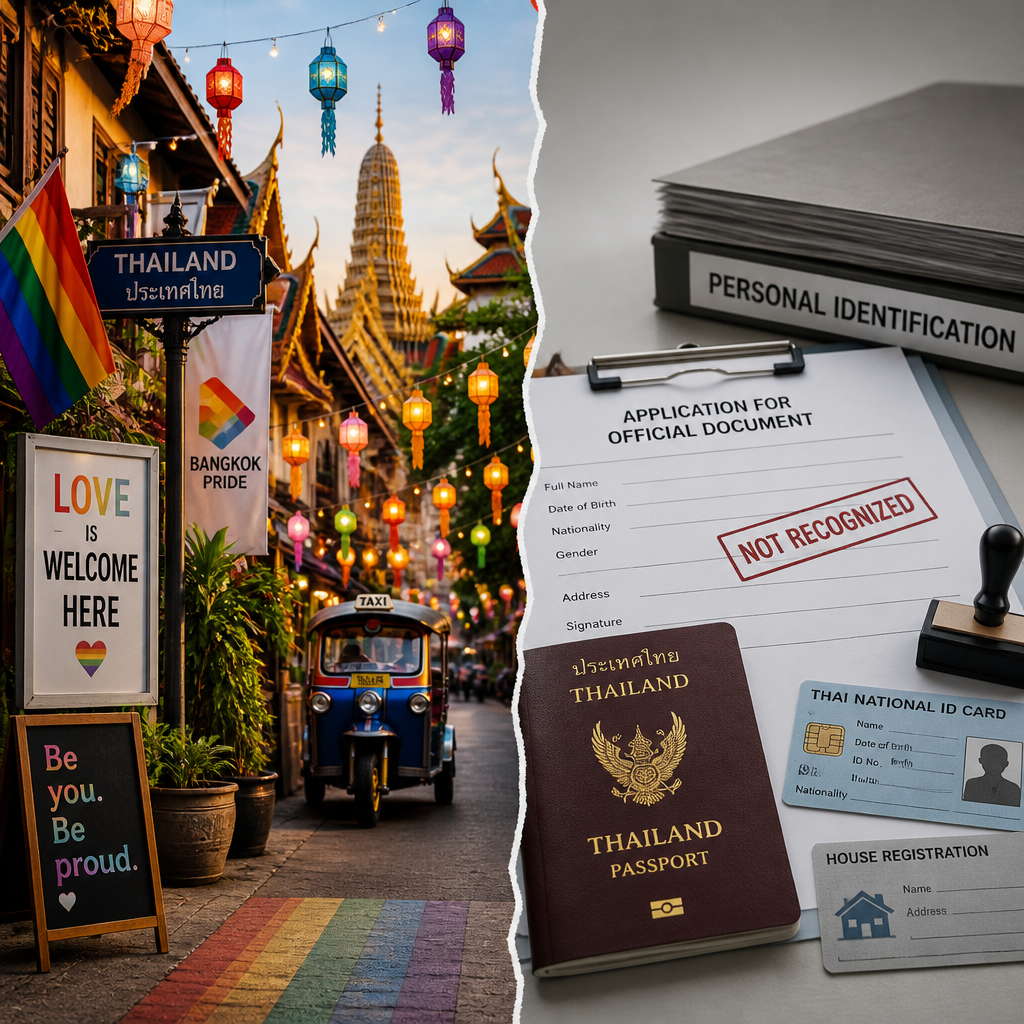
However, there is still no legal process in Thailand that allows a person to change their official gender marker on identity documents. Multiple draft gender recognition bills are under parliamentary discussion, but none had passed as of this writing. The gap between the social visibility of the kathoey community and their legal invisibility on official documents remains one of the most concrete daily hardships the community faces.
Comparing the Legal, Social, and Historical Dimensions
Dimension
Historical Position
Current Reality
Cosmological status
Recognized third gender in Buddhist and pre-Buddhist creation myths
Culturally acknowledged but not formally defined in law as a third gender category
Legal rights
Barred from court witness roles under the Code of the Three Great Seals
Protected from discrimination under the 2015 Gender Equality Act; no legal gender recognition on documents
Social visibility
Present in royal courts, temples, and community life; subordinate but visible
High visibility in media, sport, and entertainment; persistent workplace and healthcare discrimination
What Travelers Get Wrong, and How to Do Better
The single most common mistake travelers make is treating kathoey culture as a spectacle designed for their benefit. The cabaret show, the bar scene, the beauty pageant: these are real cultural spaces that exist for the community, not exhibits created for foreign consumption. Treating them that way, photographing without permission, using dehumanizing language, bargaining for services as though the person is a commodity, causes real harm and reflects a profound misunderstanding of the history described in this article.
A second common mistake is projecting Western transgender frameworks wholesale onto kathoey identity. Not every kathoey identifies as a transgender woman in the Western clinical sense. Some do, and they will tell you so. Others understand their identity through a Buddhist or traditional Thai cultural lens that has no direct equivalent in Western gender theory. The culturally aware traveler listens first and categorizes second, or does not categorize at all.
A third mistake is assuming that because Thailand is visibly tolerant, the kathoey community faces no real hardship. As this article has documented, visible tolerance and substantive equality are not the same thing. The traveler who understands this history will spend their money at kathoey-owned businesses, tip fairly, use the language an individual prefers, and advocate for the community rather than simply consuming its image.
For deeper preparation before your visit, the guides on language, pronouns, and dating etiquette available on this site give you practical tools grounded in exactly the kind of cultural specificity this history makes necessary. Understanding where the kathoey community came from is the foundation. Knowing how to speak and behave respectfully when you are actually there is what you build on top of it.
Frequently Asked Questions
Is "kathoey" an offensive term?
Whether "kathoey" is offensive depends entirely on context and the individual. As a cultural and historical term, it is widely used and generally accepted in Thailand. Some individuals in the community embrace it as a proud identity marker. Others, particularly younger urban transgender women, prefer terms like "phuying kham phet" or the English word "transgender." The safest approach is to follow the lead of the person you are speaking with and ask if you are unsure. Never use the term dismissively or as a punchline.
How far back does kathoey history in Thailand go?
Northern Thai creation myths describing a three-gender system, including kathoey as a recognized third category, date back to at least the fifteenth century. The underlying pre-Buddhist cultural concept appears to predate the formal adoption of Theravada Buddhism by Thai peoples, which occurred around the eleventh and twelfth centuries. The identity has deep roots that long predate modern tourism.
Does Buddhism accept or reject kathoey identity?
The Buddhist position is historically ambivalent rather than straightforwardly accepting or rejecting. Theravada doctrine explained kathoey existence through a karmic framework, meaning being born kathoey was seen as a consequence of past-life misconduct. This meant kathoey were viewed with sympathy rather than active hostility, since they were not considered responsible for their current condition. However, the same doctrine excluded kathoey from monastic ordination and attached a moral stigma to the identity. The result was cultural toleration without full religious equality.
Can kathoey legally change their gender in Thailand?
As of the most recent available information, there is no legal process in Thailand that allows a person to change the official gender marker on their identity documents. The 2015 Gender Equality Act prohibits discrimination on the basis of gender expression, and same-sex marriage became legal in January 2025. Multiple gender recognition bills are under parliamentary discussion, but none has passed. The gap between social visibility and legal recognition remains one of the community's most pressing practical concerns.
Why are so many kathoey visible in entertainment and beauty industries?
The overrepresentation of kathoey in entertainment, beauty, and related industries is not primarily a matter of natural preference. It reflects structural exclusion from many other professional paths, a pattern that intensified as Western binary gender norms tightened throughout the twentieth century. As documented by researchers and human rights organizations, kathoey face direct discrimination during job hiring in many other sectors. Entertainment and beauty industries have historically been more open, which is why they became concentrations of kathoey talent and labor.
What is the difference between kathoey and Thai gay men?
These are distinct categories in Thai culture, though they are sometimes conflated by outside observers. Not all gay men in Thailand are kathoey, and not all kathoey identify primarily through sexual orientation. Kathoey identity is fundamentally about gender, combining elements of femininity, gender variance, and in many cases a transgender identity. A Thai gay man who presents in a masculine way would not typically be called kathoey. The conflation of the two has historical roots in a Buddhist framework that linked non-normative sexuality with cross-gender psychology, but contemporary Thai usage generally distinguishes between them.
Have you visited Thailand and had a meaningful encounter with kathoey culture that changed how you understood this history? Share your experience in the comments below.
References
Encyclopedia of Sex and Gender: Ladyboys and Kathoeys, cultural and historical overview
Sam Winter academic paper on the cultural origins of kathoey identity in Thailand
OutRight International overview of LGBTQ+ legal rights and gender recognition in Thailand
Thailand Blog analysis of the gap between kathoey visibility and legal equality in Thai society

Comments